What Makes a Coin Valuable
How mintage, condition, and demand interact — and why age alone means very little.
Read the guide1113 Market Center Blvd Unit D, Mount Pleasant, SC 29464 · Coin dealer serving Mount Pleasant & Charleston
(843) 981-9985Collector's Corner
A single small letter can be the difference between a common coin and a genuinely scarce one. Here's where mint marks live on each denomination, what each mint's output is known for, and how to read a mark without fooling yourself.
The basics
A mint mark identifies the facility that struck the coin. Because each facility produced different quantities in different years, the mark — combined with the date — is what determines whether a coin is common, semi-key, or key.
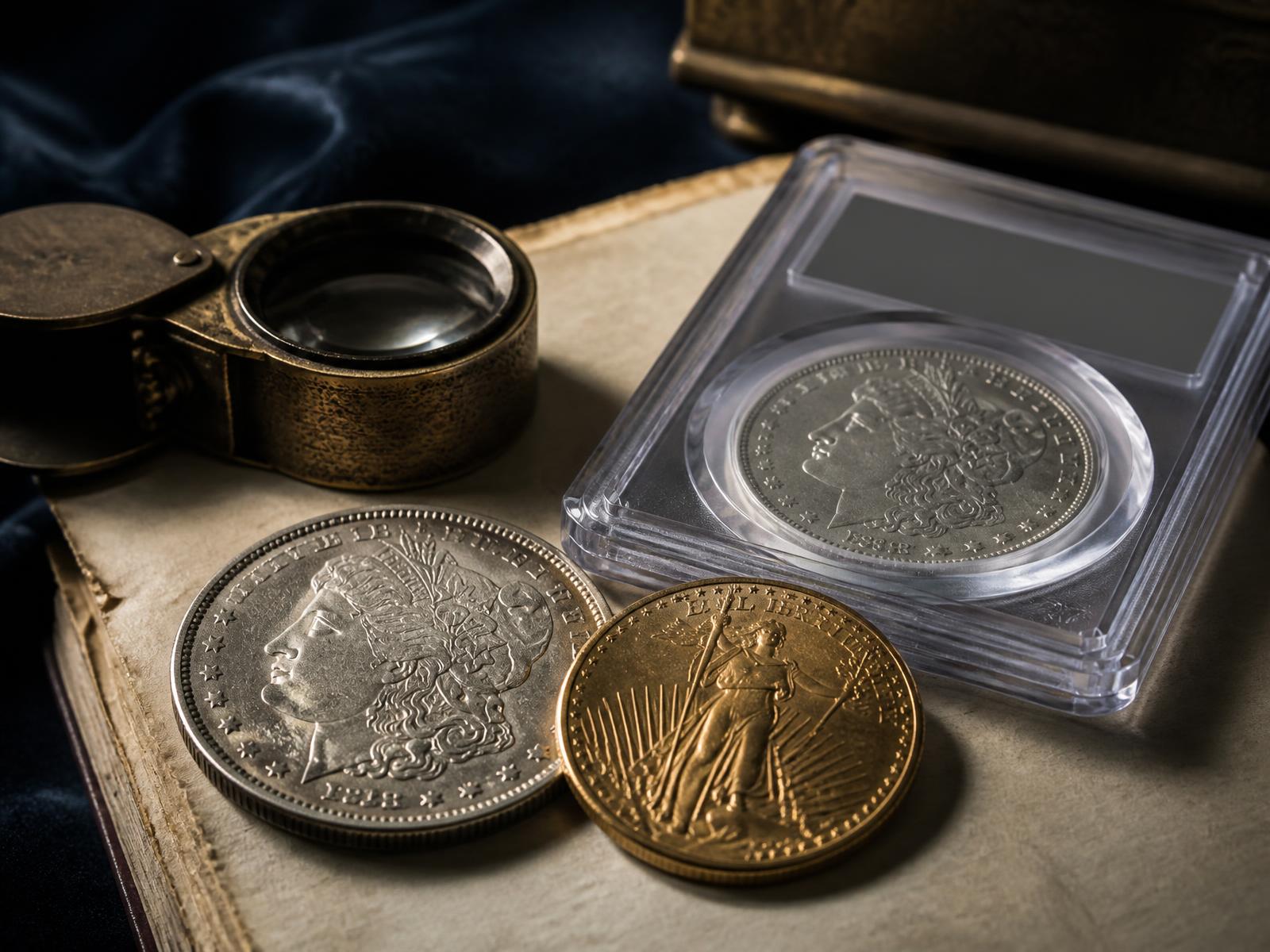
Two coins that look identical across a table can be worth a few dollars and a few thousand dollars respectively, purely because of that letter. The 1893 Morgan dollar is a good example: the Philadelphia issue is scarce but attainable, while the 1893-S is one of the most valuable regular-issue Morgan dollars in existence. Nothing about the design differs. Only the mark does.
That value gap is also why mint marks are the single most commonly faked detail on U.S. coins. Added, removed, and re-engraved mint marks have circulated for over a century. Any high-value date-and-mint combination is a coin we recommend buying certified — or having examined in person before money changes hands.
The mints
| Mark | Mint | Years | Worth knowing |
|---|---|---|---|
| P (or none) | Philadelphia | 1793 – present | The original U.S. Mint. For most of its history Philadelphia struck coins with no mint mark at all. A 'P' appears on wartime nickels (1942–1945), and on most denominations from 1980 onward — though the cent still carries no mark. |
| D | Denver | 1906 – present | The largest producer of circulating coinage today. Note that 'D' was also used by the Dahlonega mint decades earlier — but only on gold coins, and only through 1861, so the two never overlap. |
| S | San Francisco | 1854 – present | Struck circulating coinage into the 1970s and has produced most U.S. proof coinage since 1968. Older 'S' issues in high grade are frequently scarcer than their Philadelphia counterparts. |
| CC | Carson City | 1870 – 1893 | Short-lived, low-mintage, and hugely collected. Carson City Morgan dollars and Seated coinage carry a strong premium, which also makes them a common target for counterfeit and added mint marks. |
| O | New Orleans | 1838 – 1861, 1879 – 1909 | Known for softly struck silver — an 'O' Morgan dollar with a weak strike is normal, not damage, and grading services account for it. |
| W | West Point | 1984 – present | Primarily bullion and commemorative issues. A handful of 'W' quarters were released into circulation in 2019–2020, which is worth checking pocket change for. |
| C | Charlotte | 1838 – 1861 | Gold only, in modest quantities. Any genuine Charlotte gold piece is a significant coin. |
| D (Dahlonega) | Dahlonega | 1838 – 1861 | Georgia gold, gold only, and all scarce. Distinguished from Denver by denomination and date, never by the letter alone. |
Where to look
Positions moved over time — often when a design changed or when the Mint consolidated marks onto the obverse in 1968. When in doubt, check both sides at low magnification before concluding a coin has no mark.
Practical technique
Worth checking
This is not an exhaustive key-date list — it's a shortlist of combinations that turn up in inherited collections around the Lowcountry more often than people expect.
Not sure what's sitting in the folder you inherited? You don't need to identify anything before you come in. Bring it as-is and we'll go through it with you — see inherited collections or start an evaluation.
Keep reading
Bring the coin in and we'll look at it under the loupe with you — no charge for a conversation, no obligation to sell.