Collector's Corner
Coin Grading Explained
Grade is the single biggest driver of a coin's value after rarity itself. Two coins of the same date and mint mark can be worth ten times apart based on grade alone. Here's how the system actually works.
The Sheldon scale
Where the 1-to-70 scale comes from
Nearly every coin graded by a U.S. third-party service today is graded on the Sheldon Scale, a 70-point numeric scale originally devised by Dr. William Sheldon in 1949 for large cents. It was adapted decades later into the standard used across all U.S. coinage.
The scale runs from 1 (a coin barely identifiable as to type) to 70 (a theoretically perfect coin, with no visible imperfections even under magnification). In practice, circulated coins are described with both a grade name and a number, and uncirculated coins are described almost entirely by number.
| Grade range | Common name | What it means |
|---|---|---|
| P-1 to FR-2 | Poor / Fair | Barely identifiable; heavily worn, may be holed or damaged. |
| AG-3 | About Good | Major devices outlined, most detail worn away. |
| G-4 to G-6 | Good | Design visible but flat; heavy, even wear. |
| VG-8 to VG-10 | Very Good | Some detail in major devices, still heavily worn. |
| F-12 to F-15 | Fine | Moderate wear, most major details clear. |
| VF-20 to VF-35 | Very Fine | Light to moderate wear; finer details start to show. |
| EF-40 to EF-45 | Extremely Fine | Light wear on high points only; sharp overall detail. |
| AU-50 to AU-58 | About Uncirculated | Trace of wear on high points; most luster remains. |
| MS-60 to MS-70 | Mint State / Uncirculated | No wear from circulation; graded on strike, luster, marks, and eye appeal. |
Circulated vs. uncirculated
Two very different worlds
Below AU-50, a grade is mostly a measurement of wear. At MS-60 and above (or PR-60 for proofs), a coin never entered circulation, and grading shifts to a different set of criteria entirely.
Mint State grades (MS-60 to MS-70)
What graders actually look at
Strike, luster, surfaces, and eye appeal
Within Mint State and Proof grades, four factors do almost all the work in separating a common MS-63 from a premium MS-65.
Strike
Luster
Surfaces (marks)
Eye appeal
When a coin can't get a straight grade
Details grades and why they matter
Not every coin is eligible for a standard numeric grade. Coins that have been cleaned, polished, holed, bent, scratched, or otherwise altered are typically given a 'Details' grade instead.
A details-graded coin — for example, "AU Details, Cleaned" or "VF Details, Environmental Damage" — is not assigned a number. Grading services still describe the coin's apparent wear level, but the qualifying problem is noted on the label because it affects the coin's authenticity presentation and, usually, its value substantially compared to a problem-free coin of the same apparent grade.
This is one of the most common surprises for people evaluating an inherited or long-held collection: a coin that looks bright and attractive may have been cleaned decades ago, and cleaning — even gentle cleaning — nearly always reduces value rather than improving it. See our storage guide for why coins should never be cleaned at home.
Why it matters
Grade drives value more than almost anything else
For most series, the price difference between adjacent grades can be modest at the low end and enormous at the high end.
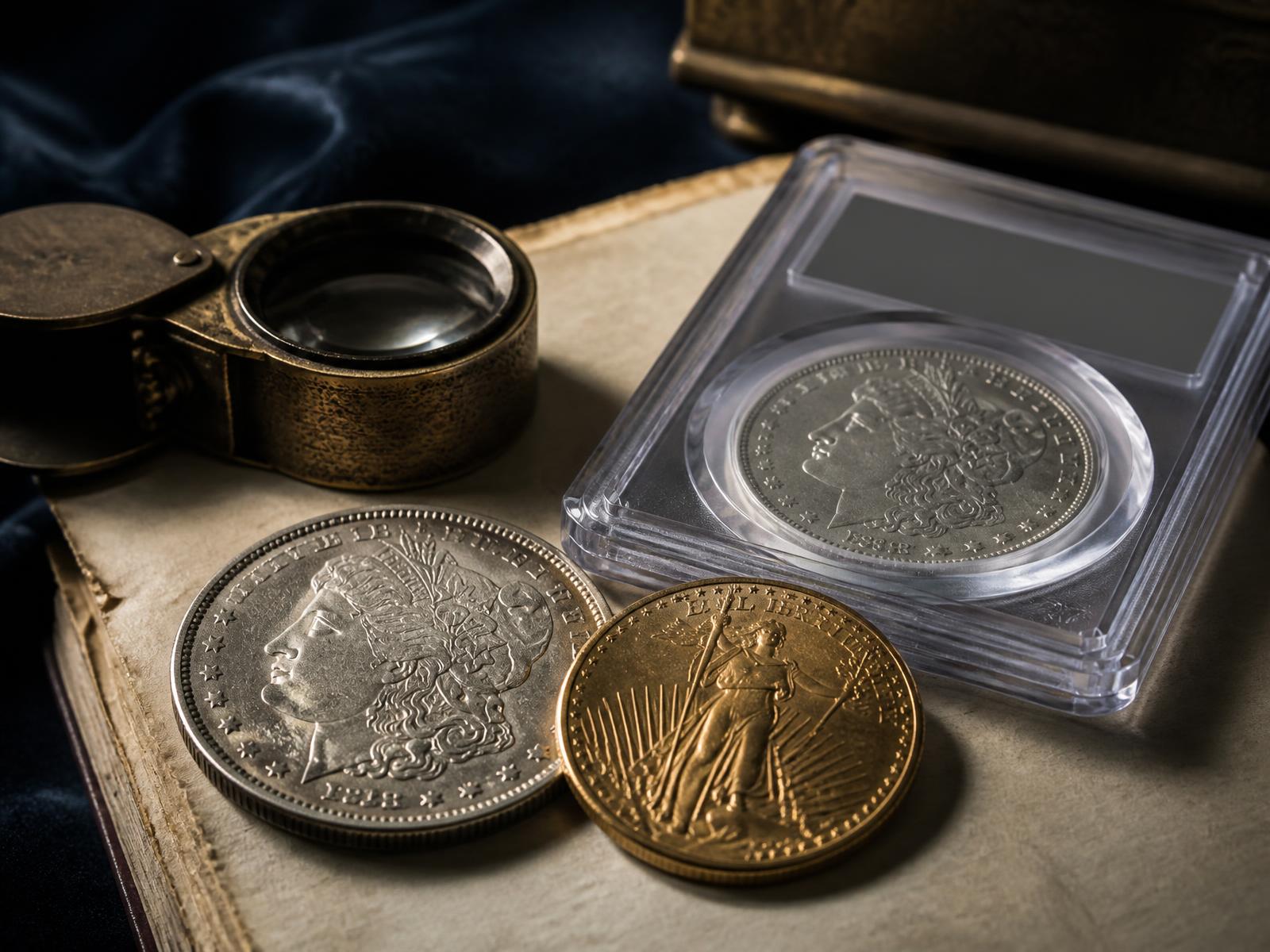
- A common-date Morgan dollar might be worth close to its silver melt value in worn, circulated grades, but a gem MS-65 or better example of the same date can be worth many multiples more.
- Key-date and semi-key coins amplify this effect — grade differences that mean little on a common coin can mean a great deal on a scarce one.
- Because so much rides on grade, and because grading involves real judgment, third-party certification from services like PCGS and NGC exists to give buyers and sellers a consistent, trusted opinion. Read our comparison of PCGS vs. NGC to understand how that works.
- A coin's grade is an opinion, not a law of physics — which is exactly why reputable grading services and a second look from an experienced dealer both matter.
Keep reading
Related guides
What Makes a Coin Valuable
PCGS vs. NGC
How to Store Coins
Not sure what grade your coins are, or what you even have? If you've inherited a collection, see our inherited collections guide or start a free evaluation and bring it in — no obligation.
Want a professional opinion on your coins?
We look at grade, authenticity, and value together, in person, at no cost to you.
